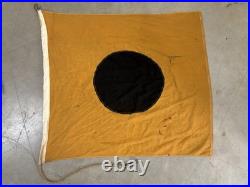
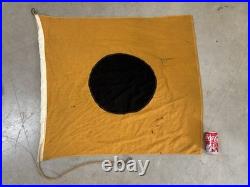

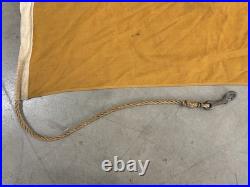
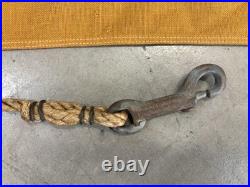
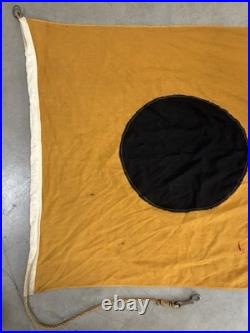
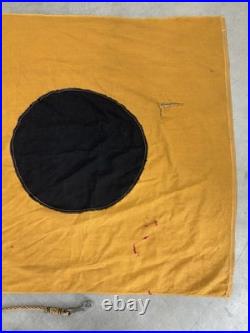
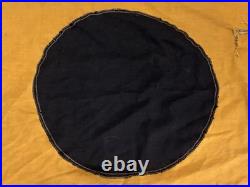
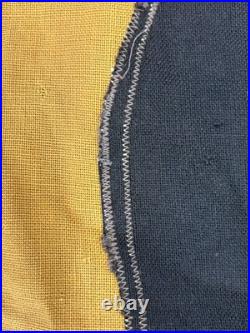
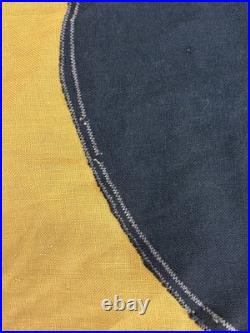
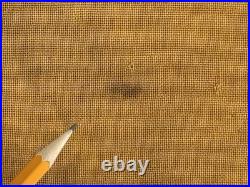
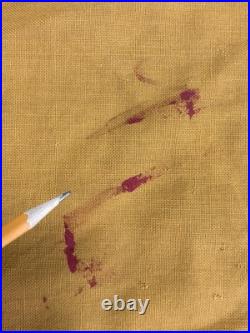


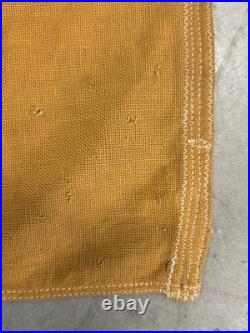
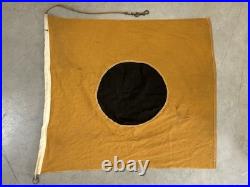

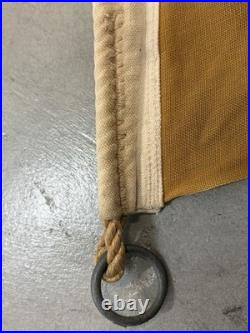
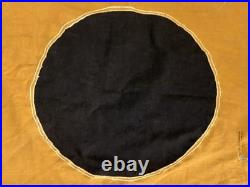
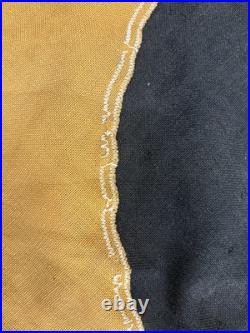
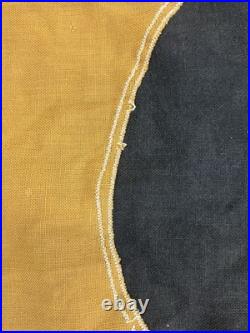

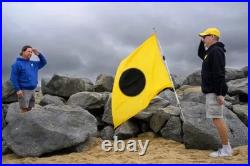
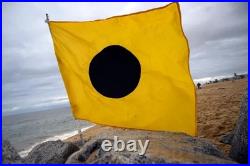
This is a culturally significant and RARE Vintage Original 1960s California SURFING No Surf BLACK BALL Beach FLAG, comprised of a thinly woven natural fabric, with a hand cut black circle sewn into the center of a mustard yellow hued field. The “blackball” flag is meant to tell beachgoers that watercraft use is prohibited, and that no surfing is allowed in a particular area. These no-surf areas are typically determined by lifeguards based on the size of the surf, the number of beach patrons, lifeguard staffing, and other safety considerations. Some speculate that the flag was created to protect swimmers during the day from surfers who may lose control and shoot out their board, resulting in painful or deadly injury. According to the United States Life Saving Association, the “blackball” flag is defined as a, … Yellow flag with black. Rectangular yellow flag with central black ball shape, 500mm diameter. This flag was first introduced in Santa Monica, California in the 1960′s, and has always been a point of contention for surfers, non-surfers, and local authorities. Newport Beach, in Orange County, California was one of the first cities to adopt the flag and is notorious among surfers for their stringent black ball regulations, specifically at The Wedge, which is known for having a highly restrictive ban on surfing during the warm season. This early handmade flag likely dates to the 1960′s and appears to be one of the very first ones ever made and used on California beaches. It’s possibly a prototype design or maquette, created by the unnamed California designer of the “blackball” flag. I could not find any pictures online of other comparably old and original “blackball” no surfing flags. Early California surfing related items are getting harder to find, and this flag is one of the scarcest California surfing related pieces I’ve ever acquired. This flag is approximately 30 x 34 inches. Good – Fair overall condition for decades of outdoor display use, with one small tear, and several stains, pinholes, and speckles of soiling throughout the flag please see all photos carefully. Acquired from an old and eclectic deceased estate collection in Los Angeles County, California. If you like what you see, I encourage you to make an Offer. Please check out my other listings for more wonderful and unique artworks! A blackball is a flag. On a lifeguard tower. Or other highly visible area to show surfers. That they must clear the water. A blackball flag is represented with a black circle in the center of a yellow or red flag; a yellow background being the most common. The flag is designed to protect swimmers. From potentially harmful surfboards. That may be moving at velocities after a wipe out. Swimmers maintain that the policy is a safety measure, while many surfers contend that blackball is an attempt to cull the in-water population in certain zones, providing preferential treatment to swimmers over surfers. Has regular headlines regarding the use of blackball and dedicates a section of their official government site to the issue. Have both made campaign issues out of the blackball implementation. Rohrabacher noted that Newport Beach was the only city who practiced blackball and also did not have a dedicated area for surf use. What is the black ball flag? It’s a surfer’s nightmare, and you can do nothing about it. The black ball flag is a synonym for “no surfing, ” even if the waves are pumping out the back. The black ball, or blackball flag, is a rectangular flag featuring a centered, solid black circle against a yellow background raised on Southern California beaches during summer. The flag waves over the lifeguard tower and prohibits hard fiberglass/polyurethane foam surfboards and skimboards in the waters of that beach. The ban can be more or less temporary (for example, during the busiest hours of the day) and less or more restricted to a specific area (for example, 100 yards to the left of a landmark). Black ball flag supporters say it represents a safety measure to protect beachgoers and swimmers from crowded summer surf line-ups. They blame surfers for hurting swimmers with their boards. First Introduced in California. The concept was introduced in Santa Monica, California, in the early 1960s and has always been at the center of a heated discussion between surfers, non-surfers, and local authorities. Newport Beach was one of the first coastal communities to adopt the black ball and, over the years, regularly discussed and implemented the black ball regulations. Home to the infamous The Wedge. Newport Beach is known for having a highly restrictive ban on surfboards during the warm season. In some situations, bodyboards and finless soft foam surfboards may be allowed in the surf. In other words, although they are all considered surf craft, some surf towns clearly distinguish between “hard boards” and soft boards. If you’re a bodysurfing enthusiast, you’ll be pleased to know that your swim fins are allowed in the waves. There’s rarely a win-win situation for surfers, bodyboarders, and beachgoers. Some parties argue that there should be no time limits on surfing or swimming; others will also say that declaring a black ball should be left to the lifeguards’ discretion. The truth is that there are no optimal answers to the heated debate. There’s no perfect formula on how to enforce the black ball flag. On the one hand, beachgoers have the right to enjoy the pleasures of swimming in the ocean. But on the other hand, surfers should be allowed to catch and ride waves on public beaches. On the opposite side of the black ball flag is the checkered flag. It tells beach users that they’re in a surfing designated area or zone dedicated to other non-powered watercraft users. One question might not have a clear answer: Should swimmers or surfers be given preferential treatment? The black ball flag discussion continues. Blackball will keep surfers away from Newport Beach. February 6, 2014 – SURFING. Surfers, bodyboarders, and skimboarders will not have more time for their sports during the Blackball period, at Newport Beach, California. Local authorities decided to keep defending swimmers interests only. Blackball is the surfers’ nightmare. The flag on the lifeguard tower has been halting riders from enjoying great wave sessions. And Newport Beach is known for its strict, swimmers-only rules. Apparently, no changes will be made. Is represented with a black circle in the center of a yellow or red flag, with a yellow flag being most common. It was created to protect swimmers from boards out in the surf. After an intense and emotional public debate, the Parks, Beaches and Recreation Commission decided to keep the rules as they are, including those which regulate the Wedge. The remaining beaches will continue raising the Blackball from noon to 4pm, between June 15th and September 10. The city of Newport Beach had a historic opportunity to balance rules for swimmers and water sports enthusiasts, but the proposals have been voted down. Words by Mat Arney, images by Catch Surf & film by Catch Surf. Initially a reaction to the black ball rules on beaches in Southern California (which require surfers on hard, fiberglass covered surfboards to leave the water when the lifeguards raise a yellow flag with a black circle in the centre), there is no doubt that soft top surfboards have gained popularity far beyond the SoCal summer in recent years. The black ball flag was first flown in California in the early 1960s as an attempt to reduce the risk of injury to water users when the beach became particularly busy and there was an increased risk of collisions between surfers and swimmers. They became common on popular beaches and in 1966 Newport Beach in Orange County began raising the black ball flag between midday and 4pm every day from early June until mid-September, with black ball season there now running from May 1st to October 31st. Inevitably, many surfers looked for ways to bend and break the rules and as busy summer beaches around the world also divided the line-ups with flags and buoylines in an attempt to keep water users safe, affected surfers experimented with oversized bodyboards that would allow them to ride waves standing up in the black ball zone. These experiments developed into the original “Black Ball Beater” surfboards released by INT surfboards. In 2002 – sub five foot, soft topped, slick bottomed and often finless (to comply with the rules) surfboards. But remarkably these surfboards, which arguably sacrifice significant performance characteristics in order to conform to the rules affecting a small number of the world’s surf population, spread beyond beaches affected by summer-time safety controls. Soft top surfboards are no longer the sole domain of surf schools as sizes shrink and increasing numbers of surfers add a beater board to their quiver for playful shorebreak sessions, inspired by footage and photos of Catch Surf. Ambassadors Jamie O’Brien and Kalani Robb. Surfers have expanded their horizons in recent years to include all manner of craft, including beater boards. Whether that’s because line-ups in some places are now crowded to the point that waves are no longer canvases but slalom courses, or simply because surfers are starting to take themselves less seriously, is hard to say, but it’s hard to deny how fun these boards look. A real’Wedge’ issue: Is it time for Newport Beach’s’blackball’ flag to come down for good? Should surfers be allowed in the lineup all day throughout the summer? Or does blackball work to protect bodysurfers and others from dangerous objects in the surf? For years, Newport Beach surfers and skimboarders have dreaded a small yellow flag with a black spot in the middle. It’s known in the stretch of coast from Big Corona to River Jetties as the “blackball” and when lifeguards raise it every summer, it means no hard floatation devices are allowed in the lineup. The blackball flies all summer citywide between the hours of noon and 4:00 p. The idea is that less surfboards in the lineup make them safer and more inviting to those visiting for a day at the beach, though surfers and skimboarders bemoan the loss of their lineup during the peak surfing season when Southern Hemisphere south swells give Newport its best waves. At the Wedge, Newport’s iconic mutant wave located just north of the entrance to the Newport harbor, blackball has become a contentious issue. Currently, the city bans all flotation devices at the Wedge every day from May 1st to October 31st from 10:00 a. To 5:00 p. But surfers and skimboarders have launched a campaign. To eliminate blackball at the Wedge, calling it discrimination. Newport Beach is looking into the matter, hosting a meeting at City Hall this past Monday to take the temperature of the community. Bodysurfer and member of the Wedge Preservation Society. History of Surfing: Blackball Blues. Matt Warshaw, on the regulatory hand-wringing of the 1960s. The bright yellow flag with the solid back circle. The signal for surfers to clear the water at many popular urban beaches, the Blackball, has made its despised path up the flagpole since the early 1960s, just as coastal communities feared the effects of surfing’s troublemakers on local beaches. An unofficial clean-up campaign ensued, as city-enforced regulations – some practical, like the Blackball; and others disciplinary, like mandatory surfboard licensing programs – cracked down on surfers. But the reasons behind the oversight were complicated. Matt Warshaw explains in the latest. Were surfing’s troublemakers A actually causing problems above and beyond that of any given group of outgoing teenagers, and B made of up glom-on newcomers? Probably not, on both scores. Miki Dora, the Windansea gang, and plenty of other surfing trendsetters were all proud, open reprobates. There were “pseudo surfers” lurking on the fringe, but not many. The rogue element in surfing was internal, and not all that menacing. Proof of this would begin 20 or so years later, when it became hard to find a boomer-age surfer who didn’t want to talk about his glory days of dropped baggies, stolen food, and lifeguard abuse. There were other forces at work. Stern, responsible-sounding voices from inside the surfing world were good for business. The surf industry was trending up, and from a manufacturers’ point of view, the bottom line could only improve if the sport was handed over to the USSA and its approved list of surf clubs-as well as organizations like the LA County lifeguards and the YMCA, both of whom now offered classes in surf instruction and safety. The “clean surfing” campaign wasn’t all blame-shifting and semi-collusive business tactics. Severson and his fellow magazine editors were also concerned about the growing number of beach towns passing restrictive surfing laws and regulations. This was hurting surfing for everyone, and hooliganism-real or perceived-was the main cause. We talked with Warshaw about the regulatory hand-wringing of the period. Were there any surf mags that embraced the rogue element? Or was most every publication and media outlet onboard with a clean-up campaign? The first issue of SURFER was actually kinda punk. There’s a picture of John Severson’s “Sunset Special” beater North Shore car, all covered in spray paint, even the tires, a ride that would have had the cops on his ass in a second if he drove it down PCH. Another photo shows a guy checking the surf wearing a ratty old woman’s knee-length coat. By the next issue, John cleaned the mag up and was becoming more of the cool but strict Surfing Deacon. The relationship between surfing and the industry seems to take a turn around this time. Surfing used to exclusively shape the industry. Suddenly, you’re seeing the industry – the creation – shape the sport, the creator. Surfboard-making up until 1960, around there – it wasn’t much of an industry. It was barely out of the garage. But let’s back up. Two things were happening. The other thing was, from 1960 forward, a lot of beach towns and cities were getting serious about anti-surfing laws and regulations. I talked to John about this once. I was kind of kidding him about how Establishment he got in the early’60s, basically trying to get him to admit that he and the rest of the Dana Point Mafia viewed the “clean up” campaign as a business opportunity, and he kind of hit back. He said the anti-surf stuff was coming down harder and faster than anybody had thought, and for awhile, he was really worried that there might be some kind of state-wide ban on surfing-or at least a lot more regs from local communities. So he was doing his best to protect the sport. I think it was both. Good business and preservation. Was there a surf break that was widely seen as the symbolic priority, above all others, to be kept free from oversight and policing? No, but I think it’s worth pointing out that in a few cases-Malibu is the most obvious-surfers carried the day. First Point was a surfing-only beach as far back as 1959. In other words, you’d get busted at Malibu for swimming, not surfing. Almost all the rules preventing surfers from riding at certain places, at certain times, had to do with keeping swimmers from getting clocked by flying 30-pound boards. Yeah, the rules were too rigid and in some cases maybe even punitive toward surfers, but you can see where city councils would err on the side of the swimmers. Swimmers were there first, plus there were a lot more of them. How did the conflicts between surfers and city officials differ from the encounters between surfers and the military at Trestles? The Trestles thing, yes, that was really a whole different conflict, a whole different game, from all the other surfer-establishment clashes. There were no swimmers to protect at Trestles. It was just a simple question of trespassing on what the military regarded as their property. Which I think, legally, it was. At that point, the’60s and early’70s, I’m not sure if there was any kind of mean high tide line right-of-way to coastal waters. Even if there had been, it wouldn’t have mattered. We were at war in Vietnam, and the Marines had the power to decide what was and was not off-limits. That said, most of the time, they didn’t bother messing with surfers. When they did, though, it sometimes got heavy. No leashes, so loose boards got confiscated. You had MPs in Jeeps, sweeping the beach. There are stories about Marines firing their weapons over the heads of surfers who wouldn’t leave the water. It was a running battle, for years and years. And the surfers eventually won! Which break had a reputation for the most unforgiving surveillance? The West Coast gets more attention, but the East Coast had way harder and more messed-up anti-surf laws. A full surfing ban for all Boston-area public beaches. In Rhode Island, you had to surf with a buddy, you had to carry a swimming certificate, you had to wear a fullsuit after a certain date. East Coast towns had less experience with surfers, and the surf boom took’em off guard, and the restrictions were, in some cases, kind of panicky. How were the fears of the rogue element in Australia similar to fear held by Americans? How were they different? Same fears, more or less, but more exciting because you had the “clubbies, ” or the lifeguards, against the surfers. So that split the youth part of the equation in two. In America, in other words, it was old vs young. In Australia, it was young surfers, vs the all the usual older groups-parents, teachers, cops-but also young club members. And then you had the Rockers coming in from the’burbs, all greased-back hair and pointy shoes, ready to fight with whomever. But we’ll save that for another time. With Vietnam, race riots, and assassinations, the surf “problem” really did become a matter of perspective. Like you write, there were bigger things to worry about. Until the boogie boarders came along. The History of Blackball at Wedge. The modern form of bodysurfing has been around since the early years of the 20. In those days, bodysurfing was the most popular water sport. Many of the top bodysurfers were also top athletes of their time. Olympians like Wally O’Connor raved about the thrills, pleasure and exercise of body surfing. It attracted many well-known football players of the mid-century too. With all these highly competitive people pushing each other to bodysurf bigger and better waves along the southern California coast, it is no surprise many found a sticking point at the end of the Balboa Peninsula. Bodysurfers are reported to have found Wedge sometime near the 1930′s. They called it The Hook. These early pioneers hurled themselves over the falls with rudimentary tools and no social media. Wedge stayed that way for many years. By the 1960′s, there was a dedicated contingent of bodysurfers and as the number of beach goers throughout Newport continued to grow the City Council was forced to shape new policies. In April of 1966 the Newport City Council issued Ordinance 1162. They designated surfing areas to protect surf bathers from hazardous surfing. The council decided the best way to communicate these established areas was through the use of signal flags. The authority to prohibit surfing set forth in subsection (b) may be exercised by displaying signal flags consisting of a solid black circle on a yellow background. When such flags are displayed on the beach they shall signify that surfing is prohibited. Newport City Council had officially adopted the Blackball Flag as a tool to protect the public. They had no idea how iconic this symbol would become. Wedge was not included in the early Blackball adoption. It wasn’t until 1978 that Wedge would be added to the protected beaches 12-4 p. During the summer months. The dedicated local crew of bodysurfers continued to grow and evolve through these ancestral generations. Alternative craft riders like kneeboarders were also present. Tom Morey’s 1971 invention, the bodyboard, sent another flood of riders into the impressive wedging shore break. According to the 1978 resolution these riders were allowed to ride waves even when the Blackball Flag was flying because Blackball. The Wedge landscape went through another transformation in 1985. According to hazy memories a bodysurfer was run over by a kneeboarder. The vocal bodysurfer urged the council to strengthen the blackball. The council agreed and in November of that same year Section 6 was added. Section 6 stated. All flotation devices such as boogie boards, surf mats, etc. Are prohibited at the area commonly known as The “Wedge” when the Blackblall Flag is displayed. This was the first direct reference to Wedge in official Newport Code. Wedge bodysurfers now had exclusive rights to the wave in the afternoon hours. While the bodysurfers had fought to gain this time to safely practice their art, they were only scrapping for the wave during the worst hours of the day. In southern California surfers are lucky to have favorable winds as late as 10 a. Much less 12 p. So, in 1993 the dedicated bodysurfers set up for another run at City Council. This time, the boys put on their Sunday’s best to ask for a chance to preserve bodysurfing’s roots and future at Wedge. This group of bodysurfers called themselves the Wedge Preservation Society and they are still around to this day. Both sides of the issue brought their case before the Newport City Council. Of May 1993 Resolution NO. 93-33 was passed and the Blackball as we now know it was born. Three key changes were enacted. The Wedge area was clearly defined as the West Jetty to tower “P”. The blackballed hours were extended to include the hours between 10:00 a. And 5:00 p. And the last major change was to extend the blackball period from May 1. Through the end of October encompassing the bulk of southern California’s south swell window. The bodysurfing community, which first pioneered Wedge, now had means to safely carry on their craft for the years to come. Fast-forward to 2014, under the guise of “fairness, ” a group of photographers and board riders attempted to rally support against the current Blackball regulations at Wedge. And the watchful eye of the other passionate bodysurfers, letters poured in from around the world to the Newport City Council expressing the importance in maintaining Wedge’s bodysurfing heritage. They decided to create a working group to gather data and put forward proposals the following year. On April 7, 2015, the Blackball Working Group recommended putting forward a resolution to both reduce the number of months Wedge Blackball should be enforced and to reduce the physical area defined as Wedge. They provided little relevant data to support the changes and in the end the resolution was not adopted. Modern Blackball policy may seem safe, but it is very clear that we cannot rest on our laurels. There are many parties of surf enthusiasts working hard to get a bigger share of Wedge waves. Maintaining vocal support for the preservation of bodysurfing’s rightful place in the Wedge lineup is up to the cultural descendants of those first adventurous riders.